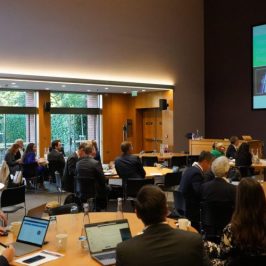
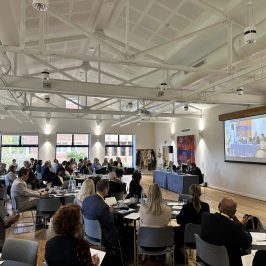
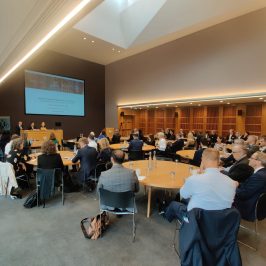
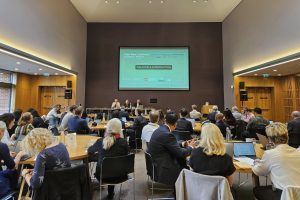
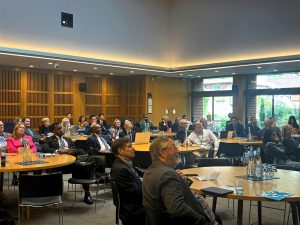
 The Cape Town Convention Academic Project (CTCAP) held its 15th Annual Conference on 23–24 September 2026 at Robinson College, Cambridge. The conference took place in a landmark year: the centenary of UNIDROIT and the 25th anniversary of the Cape Town Convention. It brought together 81 in-person experts and 33 online participants for an interdisciplinary programme on the Convention and geopolitics, drawing on international law, international relations, economics, and game theory.
CTCAP is a joint initiative between UNIDROIT and the University of Cambridge Faculty of Law under the auspices of the Centre for Corporate and Commercial Law (3CL). The Aviation Working Group (AWG) is the project’s founding sponsor. This year’s conference was sponsored by Gibson Dunn, RNC Legal, Holland & Knight, Blakes, and Clifford Chance.
Professor Ignacio Tirado, Secretary-General of UNIDROIT, opened the conference with a keynote on the Institute’s hundred years. He traced its evolution from a legal think tank of the League of Nations era to an intergovernmental organisation with 65 member States, with a portfolio now covering most areas of private law. Reflecting on UNIDROIT’s mandate, he argued that the modernisation of private law should be the primary aim, with harmonisation following. Instruments negotiated jointly by governments, industry and experts from different legal traditions offer a better path than copying foreign laws. Commenting, Professor Jan Klabbers (University of Cambridge) placed UNIDROIT within the long tradition of international organisations created to support trade and commerce.
The first day paid tribute to the late Sir Roy Goode, whose contribution to the Cape Town Convention and to international commercial law was a recurring theme throughout the conference. Rather than a series of personal recollections, the session offered a substantive tribute. Professor Jeffrey Wool (AWG) examined Sir Roy’s Official Commentary on the Convention, and Dr Orfeas Chasapis-Tassinis (University of Cambridge), Professor Ignacio Tirado (UNIDROIT) and Professor Louise Gullifer (University of Cambridge) commented. Speakers highlighted the Commentary’s authority before courts and practitioners worldwide, the rigour and independence of thought Sir Roy brought to it, and his more than fifty years of work with UNIDROIT. Participants then considered how such an authoritative interpretation of the Convention might be preserved in the future. The session closed with a minute’s silence in Sir Roy’s memory. At the conference dinner at Selwyn College that evening, Professor Charles Mooney (University of Pennsylvania Carey Law School) gave a speech commemorating the life and contribution of Sir Roy Goode.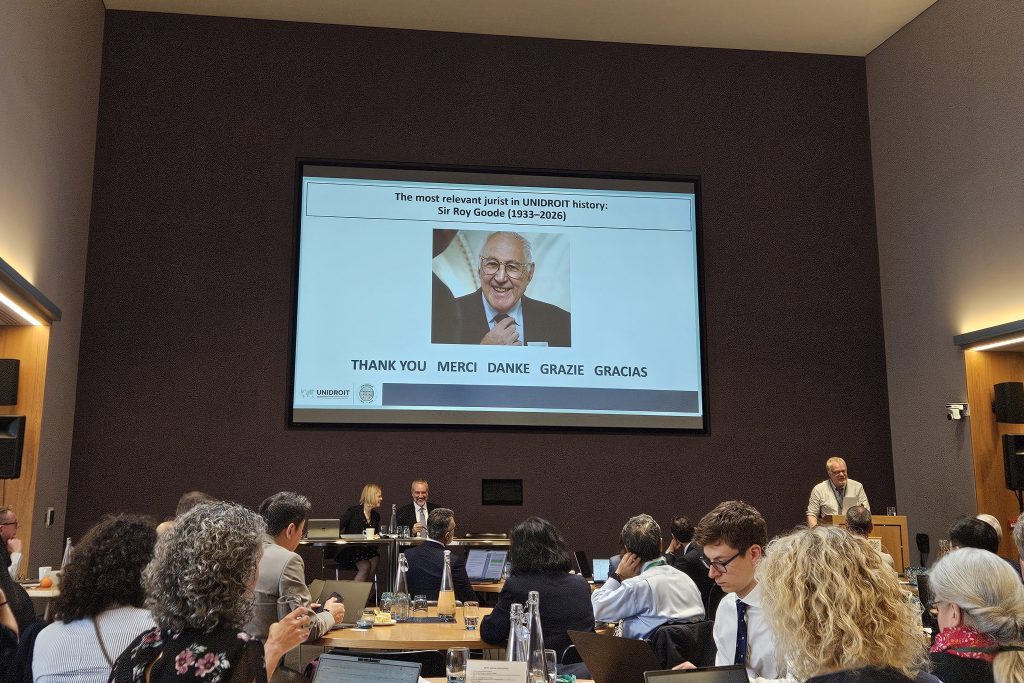
The afternoon addressed why States do, or do not, comply with the Convention once they have ratified it. Professor Tomer Broude (Hebrew University of Jerusalem) distinguished compliance, implementation and enforcement. He noted that the Convention requires compliance but does not prescribe how it is to be implemented, which leaves domestic courts and authorities with a decisive role. Dr Theresa Squatrito (London School of Economics and Political Science) brought an international relations perspective. She identified incentives, reputation, perceived legitimacy and State capacity as factors that shape compliance, and emphasised that not all non-compliance is a deliberate choice. Professor Jan Klabbers (University of Cambridge) examined how States limit or reinforce the effect of their treaty obligations. He identified the Official Commentary as an example of the epistemic authority that can strengthen a treaty’s effect in practice.
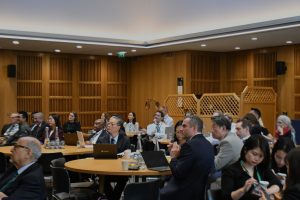
The first day concluded with a session on a future Model Procedural Law, a project that will shortly be undertaken by UNIDROIT and the AWG. Kenneth Gray (Norton Rose Fulbright) explained that the Convention leaves the exercise of its remedies to domestic procedural law. Many Contracting States either lack the necessary procedures or share similar gaps in them, which a common model law could address. Commenting from a Latin American perspective, Ken Basch (Basch & Rameh) illustrated how civil law courts may be unfamiliar with remedies such as non-judicial repossession and the Convention’s fixed time limits. He argued that a model law and accompanying guidance could help to demystify them. The experience with IDERAs in Brazil and Argentina was cited as evidence that such mechanisms can work well in civil-law jurisdictions.
The second day opened with the presentation of the Framework and the Guide on Economic Evaluation of International Commercial Law Reform, the outcome of more than a decade of CTCAP research. Dr Theodora Kostoula (UNIDROIT) explained that the instruments provide a structured methodology for assessing the likely economic impact of a private law reform before it is adopted. Reforms are scored against a comparable existing reform, and the level of certainty of the result is stated alongside the score. Professor Felix Steffek and Professor Simon Deakin (both University of Cambridge) welcomed the Framework as an important contribution. They pointed to the role that Artificial Intelligence and empirical research, including fieldwork, could play in applying it. Satoru Koyama (Japan Construction Equipment Manufacturers Association) showed how quantifying the potential benefits of the MAC Protocol for Japanese exports had helped build support for ratification among industry leaders and policymakers. Andrew Myburgh (The World Bank) emphasised the value of a credible methodology in making the case for commercial law reform.
Professor Dan Yu (East China University of Political Science and Law) presented a paper written together with Professor Kai Xiao on the application of the Cape Town Convention in China. She explained that the declarations China made on ratification reflected its economic and legal position at the time. Since then, China has become an aircraft manufacturer and a source of aviation finance, and has modernised its secured transactions law. She argued that this makes the present moment a window for reviewing China’s declarations and implementing rules, and that academic institutions could help bridge the gap between industry and government. Commenting, Professor Jeffrey Wool placed China’s engagement with the Convention in its historical context. He highlighted the practical importance of clear procedures for the Convention’s remedies.
The final session broke new ground for the CTCAP by applying game theory to the Cape Town Convention. Rob Cowan (Aviareto) and Professor Jeffrey Wool modelled the interaction between investors and governments, and competition between States for scarce capital. They showed how transparency, such as that provided by the CTC Compliance Index, and credible commitments by governments could lead to an outcome that benefits all parties: full compliance combined with lower financing costs. Commenting, Dr Ruohan Qin (University of Cambridge) suggested that games of trust could offer a further way of modelling the relationship between investors and governments, opening directions for future research.
The conference materials will be published as open-access proceedings on the CTCAP website. The event programme can be found here. Learn more about the Cape Town Convention Academic Project and its activities at www.ctcap.org.